Thoughts on the Newcomb's Paradox
Yesterday I learned about the Newcomb's Paradox.
The premise
The experiment is as follows.
You step into a room with two boxes on a table.
Box A has $1000 in it, which is a fact, no tricks played here.
The content of Box B is unknown to you.
You can make two decisions after entering the room.
Either you take only Box B.
Or you take both Box A and Box B.
Whatever is inside belongs to you.
The supercomputer
So far, so good. Now to the interesting part.
A supercomputer is also waiting in the same room. This supercomputer is very, very good at predicting what option people will choose. So it also predicts what you will choose before you have even entered the room (and knew about the experiment).
If the computer predicts that you will only take Box B, it puts $1.000.000 inside Box B before you enter the room. If the computer predicts that you will take both boxes, it puts nothing inside Box B before you enter the room.
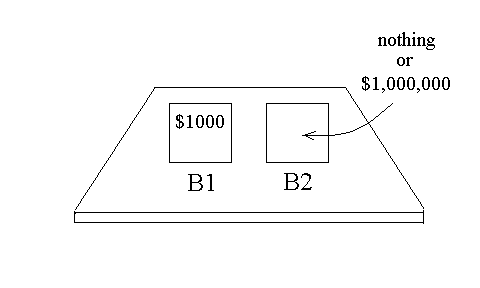
What do you choose?
I thought about it for a short time and came to the conclusion "Of course I will only pick Box B, then I go home with $1.000.000 and be happy. How is this even a paradox?". Then I learned that people decide almost evenly on both options.
My line of thinking was: If the supercomputer already knows what I will choose and is correct (almost) every time, then I can not trick it. I take only Box B, set my decision in stone, and let the supercomputer predict correctly. That is what a rational person would choose.
People who choose both boxes think: The supercomputer predicted my choice before I even entered the room and filled the boxes accordingly. Of course I take both boxes because what I choose by that time does not affect what the supercomputer did in the past. The content of the boxes is already set.
Assumptions for one box
- The supercomputer already knows what I will do and is probably right
- Changing my decision last minute would also be predicted (I can not trick the supercomputer)
- I want to take one box from the beginning and follow up with taking only one box
Assumptions for two boxes
- It is not important what the supercomputer has predicted
- The content of the boxes is set regardless of what I choose after entering the room
Closing thoughts
Where I have a problem with the decision for both boxes is that you must somehow think that the supercomputer can make errors. Even if you assume that the content is already set after entering the room, you would think that the supercomputer could have predicted wrong. I understand where people are coming from, because the content is indeed already set. But it is only set correctly in your favor (with the $1.000.000) if you would have chosen only one box. If I believe that the computer is always right, then there is no scenario where I am the person who wants to take only one box, but then takes two boxes regardless.